
MCS Certified
Microgeneration Certification Scheme
NAPIT Approved
Electrical Competency
RECC Member
Consumer Protection
ISO 45001
Health & Safety Management
ISO 9001
Quality Management
ISO 14001
Environmental Management
4.9 / 5
500+ verified reviews
Commercial Battery Storage for Essex Businesses
Take control of when and how your business uses electricity with commercial battery storage. Peak shaving, load shifting, backup power, and grid services income, all from a single intelligent energy storage system designed and installed by MCS-certified engineers across Essex.
Get Free Survey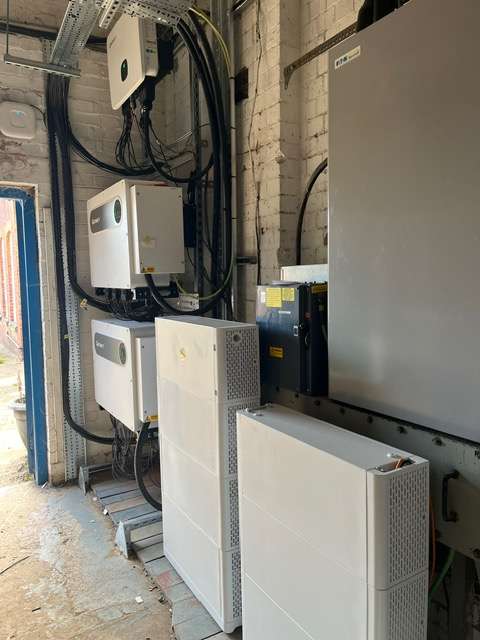
45%
Peak Demand Reduction
80-90%
Self-Consumption
4-7yr
Typical Payback
15yr+
Battery Warranty
Why Essex Businesses Need Battery Storage
Commercial battery storage has rapidly become one of the most valuable energy investments for Essex businesses. Whether paired with an existing commercial solar panel system or installed as a standalone solution, battery storage fundamentally changes how your business interacts with the electricity grid, delivering cost savings, revenue opportunities, and energy security.
The economics are compelling. Commercial electricity tariffs in Essex typically range from 22-27p/kWh, but the real cost of energy is far more complex. Most businesses pay demand charges based on their peak consumption, standing charges, and varying rates throughout the day. Battery storage allows you to optimise across all of these cost components, charging when electricity is cheapest and discharging when it is most expensive or when your demand peaks.
Peak shaving alone can reduce your electricity bills by 15-30%. Commercial demand charges penalise businesses for their highest consumption moments, even if those peaks last only minutes. A battery system monitors your consumption in real time and automatically discharges to cap peaks before they hit, reducing the demand charges that appear on every monthly bill. For businesses with variable loads like manufacturing equipment, cold storage, or EV charging, the savings are particularly significant.
Load shifting takes a different approach, exploiting the gap between off-peak and peak electricity rates. By charging batteries overnight at rates as low as 8-12p/kWh and discharging during the day when rates reach 22-27p/kWh, businesses profit from the tariff differential on every cycle. With modern lithium batteries capable of daily cycling for 10-15 years, the cumulative savings are substantial.
For businesses that have already invested in solar panels, battery storage unlocks the full potential of your solar generation. Without storage, surplus solar electricity is exported to the grid at rates of just 3-6p/kWh. With a battery, that same electricity is stored and used on-site at its full value of 22-27p/kWh. This dramatically improves the return on your existing solar investment and can reduce your payback period by 1-2 years.
Beyond cost savings, commercial battery storage provides energy security. Power outages cost Essex businesses thousands of pounds in lost production, spoiled stock, and disrupted operations. A properly configured battery system with automatic transfer switching provides seamless backup power for critical loads, keeping your business running when the grid fails.
Grid services represent an emerging revenue stream that makes the investment case even stronger. By enrolling your battery in frequency response and demand-side response programmes, you earn additional income for helping to balance the national electricity grid. This passive revenue, typically £50-£150 per kWh of capacity annually, continues to grow as the grid requires more flexibility from distributed energy resources.
How Battery Storage Installation Works
Free Survey
We assess your electrical infrastructure, energy consumption patterns, tariff structure, and available space to determine the optimal battery configuration for your business needs.
System Design
Our engineers design a battery system matched to your consumption profile, selecting the right capacity, power output, and control strategy to maximise your savings and revenue.
Installation
Battery systems are installed with minimal disruption. Indoor or outdoor enclosures are positioned, electrical connections made, and the battery management system integrated with your existing infrastructure.
Commissioning
Every system is thoroughly tested and commissioned, with control algorithms configured for your specific tariff and consumption patterns. We optimise charge and discharge schedules for maximum benefit.
Monitoring
Cloud-based monitoring tracks battery performance, charge cycles, savings, and revenue in real time. Our team continuously optimises your system's strategy as tariffs and consumption patterns change.
Typical project timeline: 4-8 weeks from survey to commissioning.
Energy Flow With Battery Storage
See how your energy system works together throughout the day.
Solar Panels
Generating
Battery
Charging 70%
Building
Using solar
Grid
Exporting
Solar powers building directly
Surplus charges battery
Excess exported to grid
Key Benefits of Battery Storage
Peak Shaving
Reduce maximum demand charges by discharging stored energy during peak consumption periods. Commercial tariffs often include significant demand charges that batteries eliminate, delivering immediate cost savings on your electricity bills.
Load Shifting
Charge batteries during cheap off-peak periods and discharge during expensive peak hours. By time-shifting your energy consumption, you take advantage of tariff differentials that can save 15-30% on total electricity costs year-round.
Backup Power
Keep critical business systems running during grid outages with automatic failover to battery power. Protect servers, refrigeration, security systems, and essential equipment with seamless backup that activates within milliseconds.
Solar Energy Storage
Store surplus solar generation for use during evenings and cloudy periods instead of exporting to the grid at low rates. Maximise self-consumption of your solar electricity to achieve the highest possible return on your solar investment.
Grid Services Income
Generate additional revenue by participating in National Grid frequency response and demand-side response programmes. Your battery can earn £50-£150 per kWh of capacity annually by helping balance the electricity grid during peak demand periods.
Future-Proof Infrastructure
Battery storage positions your business for the evolving energy landscape, including time-of-use tariffs, dynamic pricing, and vehicle-to-grid integration. As the grid becomes smarter, stored energy becomes increasingly valuable.
Commercial Battery Storage Pricing
Indicative pricing for commercial battery storage systems installed in Essex. Final pricing depends on battery chemistry, power requirements, and integration complexity.
| Battery Capacity | Installed Cost | Annual Savings | Payback Period |
|---|---|---|---|
| 50kWh | £25,000-£40,000 | £4,000-£8,000 | 5-7 years |
| 100kWh | £45,000-£75,000 | £8,000-£15,000 | 5-7 years |
| 200kWh | £80,000-£140,000 | £16,000-£28,000 | 5-7 years |
| 500kWh+ | From £180,000 | £36,000+ | 5-7 years |
Prices exclude VAT (reclaimable by VAT-registered businesses).
Battery Storage Cost per kWh and ROI by System Size
The headline installed price only tells half the story. The metric that lets you compare commercial battery storage quotes fairly is the cost per kilowatt-hour (£/kWh) of usable capacity. This falls significantly as system size increases, because the inverters, switchgear, grid-connection works and installation labour are spread across more storage. Across the UK in 2026, commercial lithium battery storage typically lands between £400 and £700 per kWh installed, with small systems higher and large deployments lower.
System Size Cost per kWh Usable Cycles / Year Indicative Simple Payback 50kWh £500–£800/kWh 300–365 6–8 years 100kWh £450–£750/kWh 300–365 5–7 years 200kWh £400–£700/kWh 300–365 5–7 years 500kWh+ £360–£620/kWh 300–365 4–6 years
The payback figures above assume a single value stream. In practice, a well-designed system stacks peak shaving, load-shift arbitrage and solar self-consumption, which shortens the return considerably. A 200kWh battery combining demand-charge reduction with overnight arbitrage commonly saves £16,000–£28,000 a year against an installed cost of roughly £80,000–£140,000.
Tax relief improves the net position further. As special-rate plant and machinery, commercial battery storage qualifies for the Annual Investment Allowance — 100% relief on up to £1m of qualifying capital spend per year — or the 50% First-Year Allowance where AIA is exhausted. Battery storage is not eligible for full expensing, but for a company paying 25% corporation tax, AIA can still reduce the effective net cost of a system by up to a quarter. VAT is reclaimable by VAT-registered businesses.
Battery Storage Cost per kWh and ROI by System Size
The headline installed price only tells half the story. The metric that lets you compare commercial battery storage quotes fairly is the cost per kilowatt-hour (£/kWh) of usable capacity. This falls significantly as system size increases, because the inverters, switchgear, grid-connection works and installation labour are spread across more storage. Across the UK in 2026, commercial lithium battery storage typically lands between £400 and £700 per kWh installed, with small systems higher and large deployments lower.
| System Size | Cost per kWh | Usable Cycles / Year | Indicative Simple Payback |
|---|---|---|---|
| 50kWh | £500–£800/kWh | 300–365 | 6–8 years |
| 100kWh | £450–£750/kWh | 300–365 | 5–7 years |
| 200kWh | £400–£700/kWh | 300–365 | 5–7 years |
| 500kWh+ | £360–£620/kWh | 300–365 | 4–6 years |
The payback figures above assume a single value stream. In practice, a well-designed system stacks peak shaving, load-shift arbitrage and solar self-consumption, which shortens the return considerably. A 200kWh battery combining demand-charge reduction with overnight arbitrage commonly saves £16,000–£28,000 a year against an installed cost of roughly £80,000–£140,000.
Tax relief improves the net position further. As special-rate plant and machinery, commercial battery storage qualifies for the Annual Investment Allowance — 100% relief on up to £1m of qualifying capital spend per year — or the 50% First-Year Allowance where AIA is exhausted. Battery storage is not eligible for full expensing, but for a company paying 25% corporation tax, AIA can still reduce the effective net cost of a system by up to a quarter. VAT is reclaimable by VAT-registered businesses.
Peak Shaving vs Arbitrage vs Solar Self-Consumption
Commercial battery storage earns its return through three distinct value streams. Understanding which one dominates for your site — and how to combine them — is the difference between a good investment and a great one. The table below breaks down how each works, the value it delivers, and the type of business it suits best.
| Value Stream | How It Works | Typical Benefit | Best Suited To |
|---|---|---|---|
| Peak Shaving | Discharges to cap your maximum kW/kVA demand and red-band DUoS charges before they hit the meter. | Cuts peak-related bills 20–40% | Spiky loads: manufacturing, cold storage, EV charging hubs |
| Load Shifting (Arbitrage) | Charges at off-peak rates (8–12p/kWh) and discharges during daytime peaks (22–27p/kWh). | Gains 10–15p/kWh per cycle | Sites on time-of-use tariffs with overnight charging headroom |
| Solar Self-Consumption | Stores surplus PV worth 22–27p onsite instead of exporting it at the 3–6p SEG rate. | Adds 15–20p/kWh; 80–90% self-use | Sites with existing or planned commercial solar |
These streams are not mutually exclusive. A single battery with intelligent control software can prioritise whichever pays most at any given moment — shaving a demand peak at 4pm, then arbitraging cheap overnight power, then soaking up solar the next morning. This value stacking is what drives the strongest returns and is why standalone batteries deliver savings even without solar.
The one constraint is capacity: the same stored kilowatt-hour cannot be used for two jobs at once, so correct sizing against your half-hourly consumption data matters. Our system design models your actual load profile and tariff to right-size the battery and configure the control strategy that maximises combined benefit rather than optimising for a single stream.
G99 Grid Connection and Working with UK Power Networks
Every battery that can interact with the electricity grid must be approved by your Distribution Network Operator (DNO). Across Essex, Hertfordshire and East Anglia, that DNO is UK Power Networks (UKPN). Getting the connection route right at the design stage is critical — it determines your project timeline, your connection cost, and which revenue streams you can access.
The connection standard depends on system size. Small inverters up to 3.68kW per phase can be connected under a simple G98 notify-and-connect process. Commercial-scale systems — and anything above 50kW — must be connected under the G99 Engineering Recommendation, which requires a formal application to UKPN and written approval before the system is energised. A full G99 application typically receives a response within around 45 to 65 working days; sites that need network reinforcement take longer.
Where a site's grid connection is constrained, export limitation under G100 is often the answer. By capping or zeroing the amount the battery can export — running it purely for self-consumption and peak shaving — you frequently secure a faster, cheaper connection and avoid costly network upgrades. Many commercial peak-shaving batteries are configured export-limited for exactly this reason.
It is worth planning ahead: grid-services income such as frequency response requires an export-capable G99 connection, whereas pure peak-shaving and solar self-consumption can run happily export-limited. We assess your existing supply capacity, advise on the optimal connection route, and manage the entire UKPN application on your behalf, so the paperwork never becomes your problem.
Battery storage benefits businesses across every sector. Explore our other commercial energy services to build a complete energy strategy.
Commercial Solar Panels
Generate free electricity from your roof
Commercial EV Charging
Workplace and destination charging solutions
Commercial Heat Pumps
Efficient heating and cooling for your building
Case Studies
200kWh Cold Storage Facility, Basildon
A food distribution company eliminated peak demand charges and secured backup power for temperature-critical stock with a 200kWh battery system, saving over £22,000 annually.
Saving £22,000/year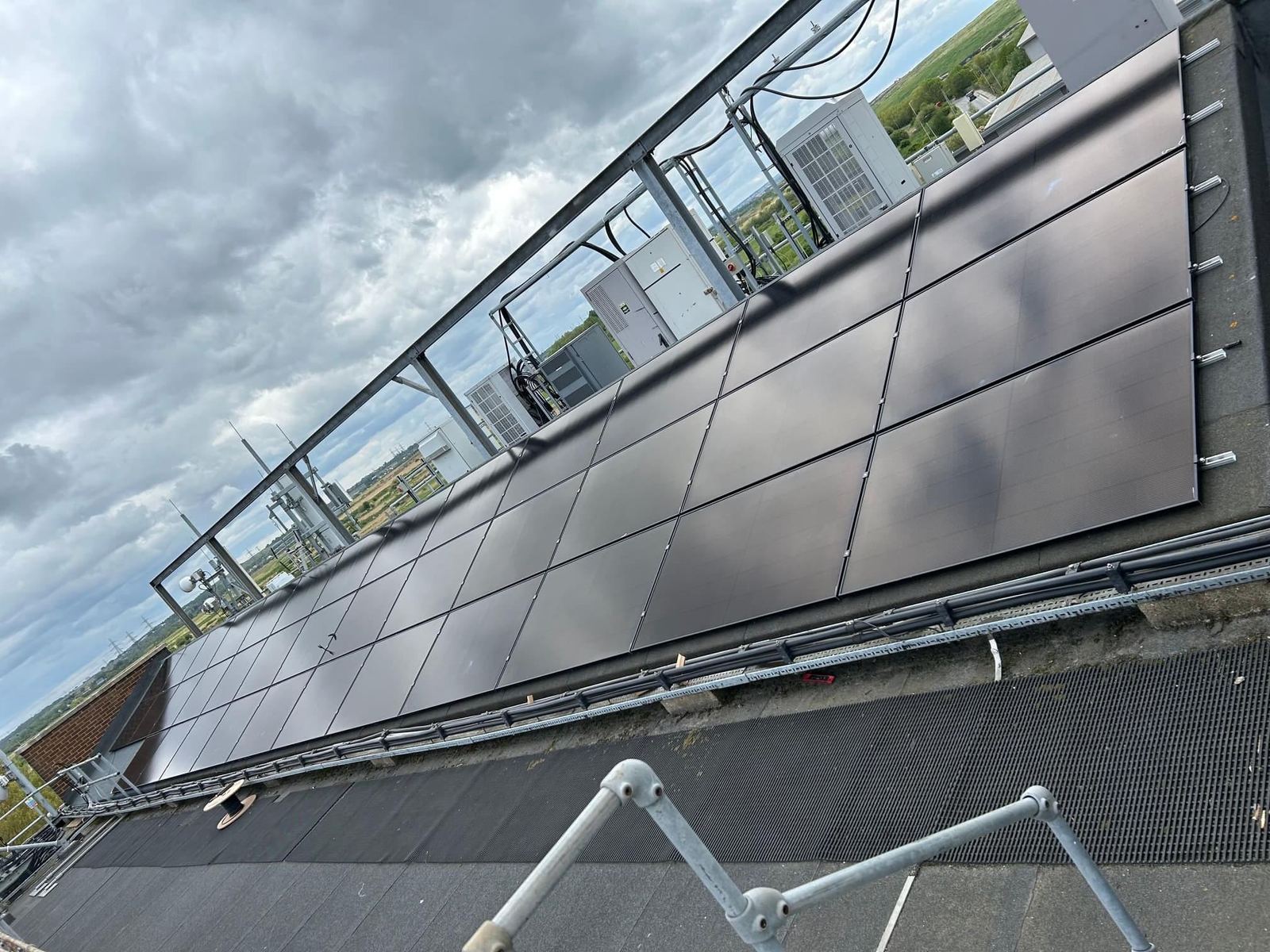
100kWh Solar + Storage, Chelmsford
An office campus added 100kWh battery storage to their existing 75kW solar system, increasing self-consumption from 55% to 92% and adding £12,000 in annual savings.
92% self-consumption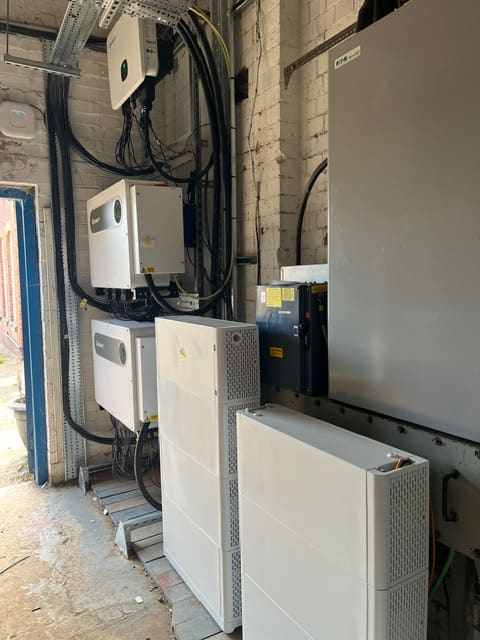
500kWh Manufacturing, Southend
A large manufacturer deployed 500kWh of storage for peak shaving and grid services, generating £45,000 in annual savings and an additional £18,000 from frequency response revenue.
£63,000 total annual benefitFrequently Asked Questions
Commercial battery storage systems in Essex range from approximately £25,000 for a 50kWh system to over £180,000 for 500kWh+ installations. The cost per kWh of storage decreases with larger systems. Pricing depends on battery chemistry, power output requirements, integration complexity, and whether the system is paired with existing solar panels or installed standalone.
Modern commercial battery systems are designed to last 10-15 years with regular cycling. Most manufacturers warrant their batteries for 10 years or a specified number of charge-discharge cycles, typically 5,000-6,000 cycles. Lithium iron phosphate (LFP) batteries tend to have longer lifespans than other chemistries. After the warranty period, batteries typically retain 70-80% of their original capacity.
Yes, commercial battery storage delivers significant savings even without solar panels. By charging from the grid during off-peak periods and discharging during peak rate hours, businesses can achieve substantial cost reductions through load shifting and peak shaving. However, pairing batteries with solar panels maximises the financial return by storing free solar electricity for use when the sun is not shining.
Peak shaving reduces your maximum demand charges by using battery power during periods of highest electricity consumption. Many commercial tariffs include demand charges based on your peak usage in kilowatts. By capping these peaks with stored battery energy, businesses can significantly reduce their monthly electricity bills, often saving 15-30% on total energy costs.
Yes, commercial battery systems can be configured to provide backup power during grid outages, keeping critical systems running. The amount of backup time depends on your battery capacity and the load you need to support. We design systems with automatic transfer switches that seamlessly switch to battery power within milliseconds of detecting an outage.
Yes, commercial battery storage systems can generate additional income through grid balancing services such as frequency response and demand-side response programmes. By allowing your battery to respond to grid signals during periods of high demand or frequency deviation, you can earn revenue from National Grid and aggregator programmes, typically adding £50-£150 per kWh of capacity annually.
Yes. Any battery that connects to the grid must be approved by your Distribution Network Operator, which across Essex, Hertfordshire and East Anglia is UK Power Networks (UKPN). Small inverters up to 3.68kW per phase can be connected under a simple G98 notification, but commercial-scale systems — and anything above 50kW — require a full G99 application and written approval before the system can be energised. UKPN typically responds within around 45 to 65 working days. Where a site cannot support full export, we configure the system as export-limited under G100, which usually secures a faster, lower-cost connection. EC Eco Energy manages the entire application on your behalf.
Commercial lithium battery storage typically costs between £400 and £700 per kWh of usable capacity installed. Smaller systems sit higher, around £500 to £800 per kWh for a 50kWh installation, while large 500kWh-plus systems fall towards £360 to £620 per kWh. The unit cost falls with scale because inverters, switchgear, grid-connection works and labour are spread across more capacity. As special-rate plant and machinery, the system also qualifies for the Annual Investment Allowance or the 50% First-Year Allowance, which reduces the effective net cost for a profit-making business.
It depends on your load profile and tariff. Peak shaving delivers the biggest wins for sites with spiky demand — manufacturing, cold storage or EV charging hubs — by capping the demand and capacity charges that penalise your highest consumption moments, often cutting peak-related costs by 20 to 40 per cent. Load shifting (energy arbitrage) suits sites on time-of-use tariffs, capturing the 10 to 15p/kWh gap between overnight rates of 8 to 12p/kWh and daytime peak rates of 22 to 27p/kWh. The strongest financial case usually stacks both, plus solar self-consumption, on a single battery, and our system design models your data to prioritise whichever stream pays most at each moment.
Battery Storage Installation Across All Areas
We install commercial battery storage systems throughout Essex, Milton Keynes, Northampton, and Ipswich. Find your area for local information.
Battery Storage
BasildonBattery Storage
ThurrockBattery Storage
ColchesterBattery Storage
HarlowBattery Storage
SouthendBattery Storage
BraintreeBattery Storage
BrentwoodBattery Storage
RomfordBattery Storage
Barking & DagenhamBattery Storage
GraysBattery Storage
StanstedBattery Storage
Milton KeynesBattery Storage
IpswichBattery Storage
NorthamptonBattery Storage
Battery Storage Guides & Insights
Expert guides on commercial battery storage, peak shaving, and integrating storage with solar.
Peak Shaving with Battery Storage
How to cut demand charges by 20-40% using battery storage. Understand demand charges, time-of-use tariffs, and the financial case.
Read article →GivEnergy vs Tesla Powerwall for Business
Side-by-side comparison of the two leading commercial battery systems. Capacity, scalability, pricing, warranty and suitability.
Read article →Solar, Battery & EV Integration Guide
How to combine solar panels, battery storage, and EV charging for maximum savings. Worked financial model and integration advice.
Read article →Get a Free Commercial Battery Storage Quote
Tell us about your site and we will design the optimal battery system for your business. Typical response within 2 hours.
Quick Quote Request
Free, no obligation estimate
Typical response within 2 hours
Based in Northamptonshire? See our dedicated commercial battery storage Northampton page for local pricing, peak-shaving use cases and grid-connection guidance.
Do commercial battery systems need planning permission?
Standalone commercial battery cabinets and containerised systems are usually treated as permitted development when installed within an existing industrial or commercial curtilage, subject to siting and height conditions — though listed settings and conservation areas can still require consent. What always applies is the grid side: any system above 3.68kW per phase needs a G98/G99 application to UK Power Networks, which we manage as standard.
For depot and warehouse sites the practical constraints are usually fire-safety separation distances and maintenance access rather than planning — both are resolved at the free site-survey stage.
North Essex? Our commercial battery storage Colchester page covers local pricing and backup-power use cases.
South Essex manufacturers: the dedicated commercial battery storage Basildon page covers peak-shaving the Burnt Mills start-up spike, local pricing and grid connection.
Ready to Cut Your Business Energy Costs?
Get a free, no-obligation site survey and quotation for your commercial property. Our MCS certified team will assess your building and provide a detailed proposal within 5 working days.
Prefer to speak to someone?
01279 295630